One Outfit, Two Silhouettes: How Layering Changes a Screen Character
One outfit, two silhouettes show how layering changes a screen character: compare the same pieces before and after to see which outline supports the scene.
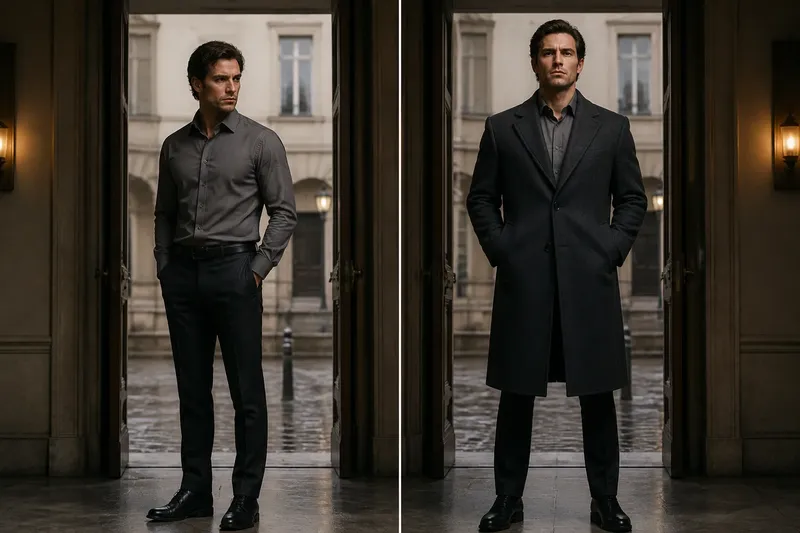
One outfit, two silhouettes can tell different stories before a character speaks. Keep the shirt, trousers, and shoes fixed, then add a structured coat: the outline can shift from close and contained to broad and imposing. The comparison matters because viewers read the body’s shape before they can inspect a button or fabric.
For costume and wardrobe, the useful question is not whether the extra layer looks attractive on its own. It is what the same outfit communicates in the actual frame, and whether the change supports the character rather than competing with the scene.
The same base outfit reads differently under a coat
Start with a simple base: a close-fitting shirt tucked into straight-leg trousers. Without an outer layer, the waist and shoulder lines remain visible, so the character may read as contained or physically slight. Add a firm-shouldered coat and leave it buttoned; the shoulders widen, the torso becomes more rectangular, and the figure can seem guarded or imposing.
This is the promised before-and-after comparison: nothing underneath changes, but the coat changes the outer contour. Open that same coat and its panels create vertical lines around the shirt. The figure may look less enclosed, though the panels can flare and broaden the outline during movement.
Which reading is useful depends on the scene’s emphasis. A broad coat can support a character who is meant to hold space in a doorway; the close base outfit can keep attention on a restrained posture or a hesitant gesture. The silhouette does not dictate a single meaning, but it gives the frame a strong first impression.
Compare the outline before choosing a layer
Look at the shoulder, waist, and hem in the intended framing. A sharp shoulder above a narrow lower body can make the figure appear top-heavy. A straight coat that falls from shoulder to hem can hide the waist and flatten the body’s shape. A short vest, by contrast, may create a clear division at the waist without changing the shoulder line.
Consider a scarf or shoulder bag as part of the same outline. A bulky scarf enlarges the area around the face; a bag introduces a corner at the hip. These details can reinforce the coat’s broad shape or interrupt it, shifting attention away from the face or a hand gesture.
Use the camera’s actual background, too. A dark strap against a dark coat may disappear, while a pale scarf against a dark jacket can read as a bright block. If the accessory should be noticed, let its edge separate clearly; if not, fold, tuck, or reposition it so it does not create an unintended accent.
Choose a silhouette that serves the scene
For a contained reading, keep the outer layer close to the body, use a soft shoulder, and avoid piling volume around the neck. For a more imposing outline, a firm shoulder or coat with a wider cut can make the upper body occupy more of the frame. Neither approach is inherently better; the choice should match the character’s posture and the scene’s composition.
When a torso looks abruptly short, check where contrasting hems and closures divide it. A pale jacket ending at the hip over a dark sweater may create a strong horizontal edge. Opening the jacket can reveal a longer central line of the sweater, making the torso look less interrupted. Think of the silhouette like a paper cutout: each new edge changes the whole shape, even if the added piece is small.
Imagine a character whose fixed base outfit is a gray shirt and dark trousers, and whose scene is framed at a doorway. In the first version, the character wears only the base outfit; the visible shoulder and waist lines make a guarded stance look compact. In the second, the same character wears a buttoned, firm-shouldered coat; the coat broadens the upper contour and makes the stance seem more imposing. If the scene calls for hesitation rather than authority, opening the coat is a third option: its vertical panels reveal the shirt and soften the enclosed shape, though the panels may spread when the actor turns. The wardrobe decision follows from the desired reading, not from a change to the base clothes.
Check the silhouette while the actor moves
A still frame cannot show every change a layer makes. An open coat may flare as the actor turns, a scarf may swing across the chest, and a shoulder bag may shift toward the front. Those movements can make a compact outline seem broad or cover a hand that needs to remain visible.
Consider the action and framing together. A wide shot may make a moving coat’s changing edge prominent; closer framing may make a scarf crossing the chest more distracting. Watch the intended action in the intended camera position, then adjust the coat, scarf, or bag if it repeatedly alters the outline or obscures a gesture.
Which version of the outfit fits the frame?
Does a thicker layer always make a character look larger?
No. A structured coat can create a deliberate, narrow shape, while a thin overshirt worn loose can broaden the body. Judge cut, drape, and shoulder line together.
What does an open coat do to the silhouette?
Its panels can create vertical lines that leave the inner outfit visible and make the torso seem less enclosed. If the panels flare during a turn, the outline may become broader instead.
How does a scarf change the upper-body outline?
A scarf adds shape close to the face, which can make the neck seem shorter or more enclosed. A compact fold keeps more of the neck line visible than a loose wrap.
Should every layer be visible?
No. A hidden layer can support the clothing without becoming a separate shape in the frame. Keep an edge visible when it helps define the character; let it recede when it distracts.
Read the outline as a costume choice
Compare the same base outfit with and without its outer layer, then follow the contour from shoulder to hem. Notice whether the coat, scarf, or bag makes the figure seem contained, broad, or visually interrupted. That comparison makes one outfit, two silhouettes more than a phrase: it is a way to identify which visible shape supports the character’s action and the scene’s framing.
Before settling on a version, check the outline during the actor’s movement as well as in a still pose. A layer that looks balanced at rest may shift across a gesture; a small adjustment to its position can preserve the intended shape without changing the outfit’s basic pieces.