How to Read Character Color in Film Costume
Learn how to read character color in film costume by tracing its visual effect, recurrence, and relationship to the frame without relying on fixed color codes.
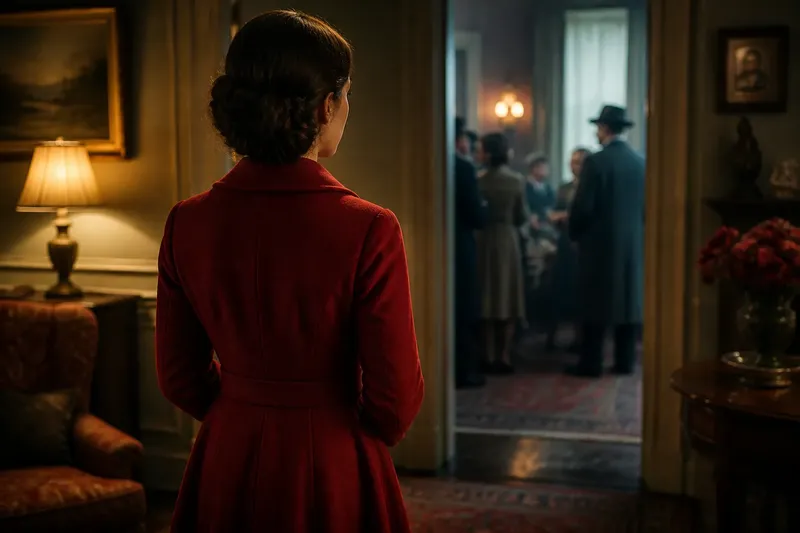
Character color in film costume works through relationships, not a fixed code. A red coat may draw the eye in a gray station, disappear among warm furnishings, or feel different when its fabric changes from matte wool to glossy satin.
To read that choice, begin with the garment’s visible job in the image: what does it separate, connect, or bring forward? That question keeps the interpretation tied to the film rather than to a universal claim about what a shade must mean.
Color changes with fabric, light, and its neighbors
A costume’s hue is only one part of its appearance. Texture and finish affect how it catches light; cut and fit affect how much of it the viewer sees. A dark green velvet jacket, for instance, reflects light differently from a dark green cotton shirt.
Lighting and nearby colors also shape perception. A pale blue dress may look cool beside amber walls, while the same dress can seem softer against a gray set. Think of a paint chip held beside different samples: its apparent character shifts with its neighbors.
Describe the visible relationship before assigning an emotional meaning. “The yellow scarf stands out against the dim corridor” names an effect on screen. “Yellow means hope” turns that observation into a rule the film may not support.
Repetition can connect scenes without acting as a code
When a color returns, consider what the recurrence links. It may travel with one character, belong to a household, or echo the palette of a particular place. These possibilities are distinct, so note who wears the color and where it appears before deciding what the pattern contributes.
Also attend to variation. A shade may return in a different material, on a smaller accessory, or against a changed background. The shift can matter as much as the repetition, especially if the scene’s staging or action gives it emphasis.
Say an invented character wears a rust-colored scarf in a quiet kitchen and later at a crowded train station. The scarf stays the same, but the second scene places it among cooler coats and a busier background. That contrast could link the moments while changing the scarf’s visual role; it would not, by itself, establish rust as a symbol of loyalty.
Contrast tells you what the frame makes prominent
A costume can stand apart through hue, brightness, saturation, texture, or formality. A pale blouse against a dark wall may become the frame’s focal point. A muted outfit among vivid clothes may instead recede, even if its color is unusual in isolation.
Notice whether the camera and blocking reinforce that difference. A close view, a pause in a doorway, or a figure placed against a contrasting wall can direct attention to a garment. If the scene gives the color no further emphasis, its distinction may serve the composition rather than a larger narrative idea.
Ask what the contrast does before asking what it symbolizes. It might separate one character from a group, make a small accessory legible, or connect a figure to the set. The performance and scene action can help distinguish among those readings.
Which clues make a color reading convincing?
Does one costume color have a universal meaning?
No shade has a fixed meaning across every film. Its effect depends on the garment, scene, surrounding palette, lighting, and patterns established on screen.
How can I tell whether a color is a motif?
Look for recurrence across scenes, people, or objects, then compare what changes each time. A repeated shade can connect moments, but the surrounding action and composition determine how persuasive that reading is.
Can I interpret costume color without knowing the designer’s intent?
Yes: describe the visible effect and qualify any interpretation. Saying that a contrast directs attention or that a repeated shade links two scenes makes a claim about the film’s image, not the designer’s private reasoning.
Can lighting change how a costume color reads?
Yes. Warm or cool light, shadow, and nearby colors can alter the shade’s apparent tone and prominence. Read it in the scene where it appears rather than assuming it looks the same everywhere.
Match the strength of the claim to the screen evidence
A single appearance can support a precise description of contrast or visual emphasis. Recurrence gives you grounds to ask about a connection. A broader interpretation needs more than a striking shade: look for support in the scene’s action, composition, and other visual choices.
- One appearance: Check the garment’s hue, fabric, and immediate surroundings. If it stands out, describe what it draws the eye toward; if it blends in, consider how that subdued effect serves the frame instead.
- A returning shade: Check which characters or objects carry it and where it recurs. If the pattern links scenes or people, describe that connection; if the context varies without a clear link, keep the reading local to each scene.
- A change in material or intensity: Check whether the shade returns in a different fabric, finish, or apparent tone. If the difference coincides with a change in the scene, discuss the contrast; if not, avoid treating the variation as a character development.
- A strong contrast with the setting: Check the costume against the set and nearby clothing. If the figure is conspicuous, identify the visual separation; if other colors compete for attention, describe the broader palette rather than singling out one garment.
- Camera emphasis: Check whether framing, a close view, or blocking isolates the costume. If the image repeatedly directs attention to it, consider a narrative connection; if not, describe its compositional role without asserting a motif.
- Several people wearing similar tones: Check whether the color belongs to a group or household as well as an individual. If it is shared, consider a collective visual pattern; if it is specific to one person, describe that distinction without assigning a universal meaning.
Character color in film costume becomes easier to discuss when you separate what is visible from what you infer. Name the garment, its material, its neighbors, and any recurrence; then make only the claim those details can carry. A careful reading can leave meaning open while still explaining exactly how color shapes the image.