A Historical Costume Research Checklist for Film Designers
Use this historical costume research checklist to sort sources, identify gaps, and make clear design decisions that connect period evidence to character.
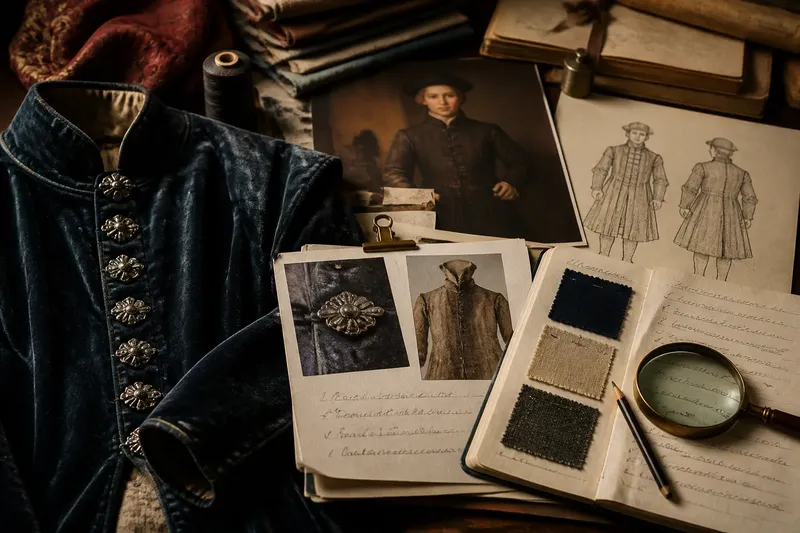
Historical costume research for film is strongest when every design choice can be traced to a source, an inference, or a production need. A portrait, inventory, and surviving garment offer different kinds of evidence; treating them as interchangeable can turn a specific past into a generic period look.
Define the character’s historical context before choosing garments
Start with the setting the script actually establishes: place, approximate period, social group, occupation, and occasion. A date alone cannot tell a designer what a character would wear. Court clothing varied by region and rank, while formal ceremonies called for different dress than work or private life.
Write down what the scene makes clear and what remains undecided. If the script gives no precise region, mark that as an open choice rather than quietly borrowing details from several courts. This boundary keeps research focused and makes later design decisions easier to explain.
Use each source for the evidence it can provide
A surviving garment can reveal construction, material, and signs of alteration, but it cannot by itself represent everyone who lived in its period. A portrait can show how a sitter wanted to appear, along with visible dress details, but may idealize status or conceal ordinary use. Inventories can name belongings, though they often leave unanswered how items were worn together.
Record the source type beside each observation. “The portrait shows a dark outer garment” is different from “the character’s rank required a dark outer garment.” The first describes visible evidence; the second is an interpretation that needs separate support.
Historical costume research checklist for film designers
Use this checklist to turn broad research into decisions the wardrobe team can act on. Each item identifies what to inspect and what to do if the evidence is incomplete or conflicting.
- Setting: Check the script for place, period, social group, and occasion. If all four are clear, use them to narrow the source search; if a detail is missing, flag it for a production decision instead of blending unrelated references.
- Source type: Check whether each reference is an object, image, written record, or later interpretation. If the source directly supports the detail you need, record it as evidence; if not, use it only as context and seek a more relevant source.
- Garment construction: Check surviving-object photographs or collection descriptions for seams, closures, and shape. If those details are visible, note which can inform the costume build; if they are hidden or uncertain, leave the construction open rather than presenting a guess as fact.
- Wearer and rank: Check who is shown or described wearing the garment and under what circumstances. If the wearer matches the character’s social position and occasion, consider the reference; if not, look for a closer match or mark the adaptation as interpretive.
- Regional fit: Check where the source originated and whether that location matches the story. If it does, retain it as a relevant reference; if it does not, search for a local source or make the geographic mismatch explicit in the design notes.
- Source date and context: Check when and why an image or record was made. If it documents the relevant period and purpose, use it with its limits noted; if it is later or commemorative, treat it as evidence of memory or representation rather than direct documentation.
- Conflicting details: Check whether sources disagree on cut, color, or use. If a stronger source resolves the conflict, follow it and record why; if neither source takes precedence, choose one coherent direction for the production and label the choice as uncertain.
- Missing voices: Check whose clothing appears repeatedly and whose is absent from the record. If the evidence is concentrated on elites, avoid treating it as universal; seek work-related or local sources where available, and state any remaining gap in the design notes.
Separate documented details from design interpretation
A useful research record distinguishes observation, inference, and decision. An observation might be a visible fastening in a portrait. An inference might be that a similar fastening suits a character of comparable status. A decision might be to use a readily legible version because the scene requires the audience to recognize the character’s affiliation.
Say a fictional production sets a council scene at a court, and its junior clerk has recently gained access to formal meetings. The team finds a portrait showing a small metal fastening on an attendant’s coat, an inventory listing costly cloth for senior officials, and no direct source for clerks’ meeting clothes. It records the fastening as observed evidence, treats the clerk’s access as a reason to consider a court-associated detail, and chooses a modest replica while keeping the outer garment plain. The resulting costume signals entry into the court’s world without claiming that the missing record establishes a standard clerk’s uniform; the tradeoff is a clear visual distinction built partly on interpretation.
How should designers handle uncertain historical evidence?
What if two sources contradict each other?
Check whether they come from different places, occasions, or dates before choosing between them. If neither better fits the scene, select one consistent direction and record the disagreement rather than presenting the choice as settled history.
How can a designer research clothing for people rarely shown in archives?
Look for relevant local records, work-related images, written inventories, and surviving objects, while noting who created each source and whose lives it leaves out. When evidence remains sparse, distinguish a careful design inference from a documented fact.
When is it reasonable to adapt a historical garment?
Adaptation is reasonable when the production has a specific need, such as allowing a performer to move or preserving a documented feature with a different construction. Record what changes and what evidence the design retains so the adaptation does not become an unexplained claim about period dress.
Should every costume choice be historically documented?
Not every detail can be documented, especially when sources are incomplete. The useful standard is to identify which choices have direct support, which are informed inferences, and which serve the production’s interpretation.
Keep the research trail useful to the wardrobe team
Store source images, descriptions, and decisions together, with a short note explaining what each item supports. That record helps the team keep related costumes coherent as designs change, and it lets collaborators distinguish a historical reference from a choice made for the story.
A historical costume research checklist is most useful when it records uncertainty alongside evidence. When the wardrobe makes a debatable choice, the note should name the source, the inference, and the alternative considered. That small distinction preserves room for interpretation while keeping the screen’s version of the past honest about what is known and what has been supplied.